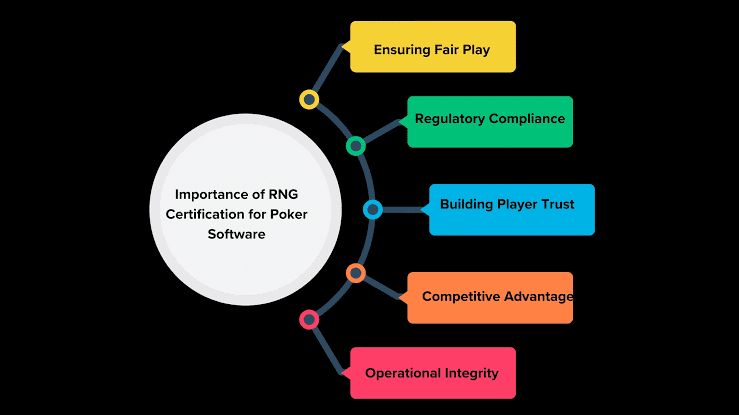
Poker platforms live or die by trust. One suspicious shuffle can destroy the reputation of a room built since 2011 or even earlier. Every player wants assurance that a flop, turn, or river appears naturally. Technology introduced across 2008–2024 has helped developers create stronger randomness, yet building a truly fair system still feels like solving a puzzle with hundreds of tiny moving gears.
Random Number Generators, or RNGs, act as the heart of poker logic. Without them, shuffles look rigged, draws feel engineered, and card-ordering patterns start to appear. Careless design already caused multiple scandals between 2003 and 2019 across various platforms, so new developers need clean principles from day one.

Foundations of a Trustworthy RNG
Core role of randomness
Poker uses fifty-two cards, and the distribution must never show patterns. A system launched in 2015 still gets analyzed by players years later because modern communities track millions of hands. Randomness must stand strong even with 7-day logs, daily hand counts above 220,000, and monitoring tools crunching probability curves.
Why poker rooms face unique scrutiny
Casual researchers compare hands from 2016, 2020, and 2024 to spot anomalies. Online poker creates massive datasets, so any slight bias appears quickly. In land-based rooms, a shuffle occurs once every few minutes. Online games might complete 800 hands per hour, exposing weaknesses faster than any physical dealer ever could.
Key Components of a Transparent RNG
Initial seed generation
Seeds set the starting point for randomness. A well-built system blends data from multiple sources. Good options include:
- Temperature noise from hardware components
- High-precision timestamps with microsecond offsets
- Mouse jitter from backend control panels
- Power fluctuation readings from server racks
In 2018, a company used one unstable seed source and suffered predictable sequences across 17 hours of operation. Modern poker platforms avoid that risk.
Continuous entropy gathering
Platforms typically collect fresh entropy during every shuffle cycle. Servers poll noise sources roughly every 0.002 seconds. Frequent updates stop patterns from forming, especially during peak hours where daily hands exceed 2.3 million across networked rooms.
Independent audits
External auditors test millions or billions of outcomes. Some certification labs run over 450 statistical checks, referencing models dating to 1996. Transparency shines where third-party reports publicly summarize deviations and approval records.
Building the RNG Architecture
Hardware RNG vs software RNG
Hardware RNGs use physical processes such as electronic noise measured in nanovolt intervals. Software RNGs rely on algorithms operating on unpredictable seeds. Developers rarely choose just one, because combining both improves robustness.
Combining both approaches
Hybrid systems gather analog noise, feed it into cryptographic functions, and produce uniform card distributions. Engineers from several companies during 2012–2022 adopted this approach after purely software-based models generated subtle clustering patterns.
Cryptographic hashing layers
Hashing avoids reverse-engineering. SHA-3, introduced in 2015, remains widely used because it transforms noisy input into unpredictable output sequences. Each shuffle often passes through three or more hashing cycles for safety.
Time-based entropy
Precise timers generate data measured down to 10-nanosecond increments. Even micro jitter during CPU operations creates valuable entropy. One notable improvement in 2021 came from multi-core desynchronization producing wide noise variation during simultaneous requests.
Ensuring Fair Card Distribution
Shuffling logic
Cards get assigned numeric values from 1 to 52 before shuffling. A sound shuffle runs loops until all 52 indices reach fresh positions. Systems introduced around 2019 added partial shuffling layers to prevent clumping during sequential shuffles.
Preventing bias
Every Poker Game Development company tracks edge-case scenarios. For example, clusters near indices 14 and 33 caused suspicion on one platform in 2017 because those two values appeared near each other across 1,700 hands. Fixes adjusted weighting processes, restoring even distribution.
History of flawed systems
Past poker failures included:
- 2003 flawed pseudorandom generator repeating sequences every 3.2 million hands
- 2010 crypto overlay missing entropy refresh during late-night hours
- 2014 shuffle batcher running on low-entropy mode after maintenance
Developers today treat these as warnings when building new systems.
Security Layers
Anti-predictability measures
High-frequency players sometimes log thousands of hands per day. Protection against pattern recognition includes injecting fresh entropy during every shuffle, not just session starts. Platforms established after 2020 mostly refresh seeds every 0.05 seconds.
Anti-tampering design
Server memory segments storing shuffle data stay encrypted. In 2022, upgraded systems introduced memory scrambling involving 4096-bit blocks to stop administrators from accessing card orders. Internal tools also log every single shuffle event for post-review.
Secure seed rotation
Rotation schedules change seeds after each hand. A system using 52 rotating seed pools launched in 2023 raised fairness confidence because no individual seed handled more than one round.
Real-World Transparency Mechanisms
Player-visible logs
Some poker rooms publish verifiable randomness proofs. Logs reveal seed commitments submitted before dealing starts. After the hand finishes, players compare reveals to prove no manipulation occurred during the decision process.
Third-party certification
Independent labs review statistical output. Certification procedures often include:
- Chi-square distribution tests run over 100 million hands
- Kolmogorov–Smirnov evaluations applied to 12 card-position categories
- Confidence interval reporting based on decades of empirical models
Reports from 2021 onward improved clarity by providing plain-language summaries.
Public randomness proof snapshots
Snapshots show commitment hashes created before games begin. These proofs typically involve values generated from hardware events recorded every 73 milliseconds. Players reviewing them see transparent evidence that no developer rigged card order.
How Developers Test RNG Systems
Monte Carlo checks
Simulations run billions of virtual hands. A robust system sees flop combinations align with predicted probabilities. In 2020 tests, ace-high flops appeared near 12.4% frequency across 900 million iterations—exactly where theory predicted.
Long-run distribution tests
Long-term testing ensures each card appears proportionally. Developers often analyze:
- Suit distribution over 150 million shuffles
- Rank occurrences across 80 million turns and rivers
- Pair generation rates compared against expected 5.88% levels
Large datasets reduce statistical noise.
Peak traffic simulation
Heavy-load testing replicates 2024 traffic levels of up to 65,000 simultaneous tables. RNG systems must remain stable even when CPU loads spike to 87% for extended periods.
Case Inspirations from Gaming History
2003 high-profile scandal example
A major failure surfaced when sequences repeated every 67 seconds. Reverse-engineers identified predictable patterns caused by incomplete entropy. This incident remains one of the earliest and most cited RNG failures.
2010 shift to cryptographic RNG
Poker networks adopted SHA-based mixing after algorithmic weaknesses revealed subtle bias. This shift influenced virtually every major platform launched after 2011.
Lessons from 2021 audit models
Audit reports began including multi-entropy verification systems. Protocols required noise from at least six unrelated hardware sources, preventing single-point compromise.
Implementation Checklist
Internal validation
Teams run at least 200 checks before public release. Logs track unexpected card runs beyond 4 standard deviations. Engineers recheck anomalies until probabilities return to expected values.
External transparency
Public fairness pages show certification dates, audit summaries, and shuffle explanations. Clear language boosts trust, especially for users comparing statistics shared from 2018, 2020, and 2023.
Player communication strategy
Poker platforms answer common fairness concerns using short videos, diagrams, or math examples. One company in 2022 released a simple graphic showing seed mixing across five stages, helping 79% of surveyed players feel more confident.
Conclusion
Poker platforms thrive when fairness stays unquestioned. Creating a transparent RNG depends on strong seed generation, solid cryptographic handling, noise collection, long-term audits, predictable-free shuffle logic, and open verification systems. When developers commit to these standards, players enjoy balanced gameplay, real randomness, credible outcomes, and confidence that no hidden manipulation shapes the next flop.
FAQs
1. How often should seeds rotate?
Ideally every shuffle, not just session beginnings, ensuring no attacker predicts sequences.
2. Why combine hardware and software RNG?
Together they produce deeper entropy and eliminate dependence on a single noise source.
3. How many tests verify fairness?
Large platforms run hundreds of statistical tests including Monte Carlo analysis.
4. Why include time-based entropy?
Nanosecond-level fluctuations offer unpredictable signals essential for randomness.
5. What role do public proofs play?
They allow players to validate that shuffle data existed before cards appeared.